
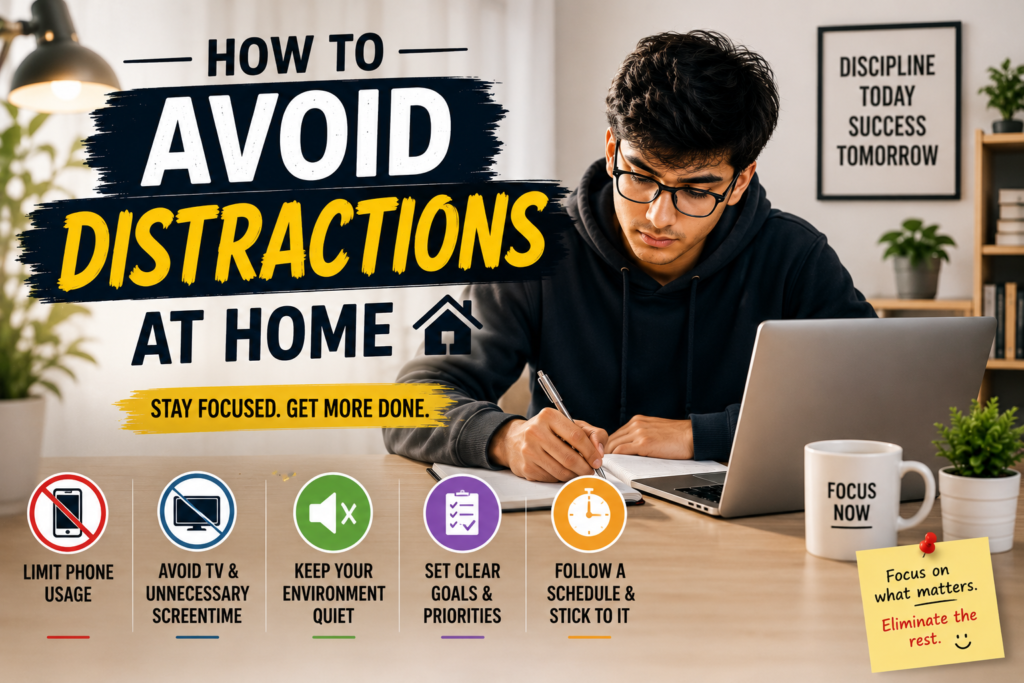
How to Avoid Distractions at Home
Studying or working at home can be really tough. Your bed is there your phone is buzzing all the time and family members might interrupt you.. You have entertainment available all the time.
A lot of people think they have a problem with focusing. Really they just have a problem with distractions.
The goal is not to make your home perfect. The goal is to get rid of things that distract you so you can focus easily.
This article will show you ways to avoid distractions at home.
1. Create One Dedicated Work Area
Do not work over the house.
Choose one place to:
- Study
- Work
- Read
Do not work in:
- Your bed
- On the sofa
- In front of the TV
Your brain will start to connect places with certain habits.
2. Put Your Phone Away
Phones are a distraction.
Try to:
- Keep your phone in another room
- Turn off notifications
- Use a focus mode on your phone
If your phone is next to you you will keep looking at it.
3. Decide What You Will Do Before You Start
Do not just sit down and think:
“What should I do?”
Write down:
- What chapter you will study
- What task you will complete
- How time you will spend on it
When you have a clear plan you can focus better.
4. Use Time Blocks
Work for a set amount of time then take a break.
For example:
- Work for 45 minutes
- Take a 10 minute break
When you are working:
- Do not scroll through your phone
- Do not send messages
When you’re on a break:
- Take a walk
- Stretch
- Drink some water
5. Keep Your Desk Clean
When your desk’s cluttered your mind is cluttered too.
Keep only:
- Your notebook
- A glass of water
- The tools you need
Get rid of:
- devices
- Random papers
A simple workspace helps you concentrate.
6. Tell People Your Focus Hours
If you live with family or others tell them:
“I will be working from 10 to 12.”
People are less likely to interrupt you when they know you are busy.
7. Use Website Blockers
If you keep going to distracting websites use a blocker.
For example:
- Limit your time on media
- Block entertainment sites
Do not just rely on your own self-control.
8. Wear Headphones or Reduce Noise
Noise can break your concentration.
You can:
- Find a room
- Use earplugs
- Listen to music
You do not need complete silence to work.
9. Avoid Multitasking
Do one thing at a time.
For example do not:
*. Watch videos at the same time
- Work and chat at the same time
It is better to focus on one task and do it well.
10. Keep a Distraction List
When random thoughts come up write them down.
For example:
- Things you need to search for later
- Messages you need to reply to
- Things you need to buy
Write it down. Keep working.
11. Set Start and End Times
If you do not set boundaries work can feel endless.
For example:
- Start work at 8:00
- Finish work at 10:00
Having a schedule helps you stay focused.
12. Control Your Environment
Your environment affects your behavior.
For example:
- Good lighting
- A comfortable chair
- A clean room
Small changes can make a difference.
13. Avoid Starting With Easy Entertainment
Many people wake up and immediately:
- Scroll through their phone
- Watch videos
- Check notifications
Your brain will start to expect stimulation all the time.
Protect your mornings.
14. Use the Two-Minute Rule
If starting work feels hard just work for two minutes.
Starting something can create momentum.
15. Reduce Open Tabs
many tabs can be distracting.
Keep what you need and close the rest.
16. Eat and Drink Properly
When you have energy you cannot focus.
Simple habits like:
- Drinking water
- Eating meals
can help. Do not just rely on caffeine.
17. Take Real Breaks
Breaks should help you recover and focus again.
Better breaks are:
- Taking a walk
- Stretching
- Deep breathing
Not just scrolling through your phone.
18. Train Your Attention
Your attention gets better with practice.
Spend time:
- Reading
- Studying
- Doing work
Reduce the time you spend on short-form content.
19. Stop Waiting for Motivation
You do not need to feel motivated to start.
Action can create motivation.
Just start.
20. Use a Daily Plan
example:
- Morning: work
- Afternoon: light tasks
- Evening: review
Planning reduces confusion.
21. Avoid Perfection
Some days will be harder than others.
Just keep going.
Consistency is more important than perfection.
22. Limit Notifications
Most notifications are not important.
Turn off:
- Social media alerts
- Extra app reminders
Protect your attention.
23. Sleep Properly
When you do not sleep well you get distracted easily.
Good sleep helps with:
- Memory
- Focus
- Energy
Sleep is part of being productive.
24. Reward Completion
After finishing work reward yourself:
- With a cup of tea
- A short walk
- Some entertainment
Reward your progress.
25. Build a Routine
The decisions you make the harder it is to focus.
Create routines:
- Same workspace
- Same time
- Same process
Routine reduces resistance.
Example Focus Routine at Home
8:00 AM. Start work
8:45 AM. Break
9:00 AM. Continue
10:00 AM. Walk
10:15 AM. Deep work
12:00 PM. Finish
Simple routines often work better than systems.
Final Thoughts
Avoiding distractions at home is not about being perfectly disciplined.
It is, about:
- Reducing interruptions
- Controlling your environment
- Protecting your attention
- Creating routines
- Starting small
You do not need conditions to focus.
You just need habits that make it easier to focus every day.
Оземпик представляет собой передовым медикаментом для терапии сахарного диабета второго типа.
Данный медикамент вводится путём инъекций раз в 7 дней благодаря удобной шприц-ручки.
Центральное воздействие Оземпика — стимулировать рецепторы ГПП-1, что приводит снижение уровня сахара в плазме.
Tirz.pro
Кроме контроля гликемии, препарат помогает умеренному избавлению от лишних килограммов.
Курс Оземпика должен назначаться исключительно эндокринологом с учётом всех противопоказаний.
Во время терапии могут встречаться побочные явления, например расстройство желудка или нарушение стула, которые обычно проходят со временем.